

Many fleet managers worry that electric vehicle charging will create bottlenecks and downtime that slow operations. This concern often stems from experiences with slow home chargers or outdated public infrastructure. Commercial rapid charging changes this equation entirely, delivering power outputs that can replenish fleet vehicles in minutes rather than hours. This guide explains what commercial rapid charging means for your operations, how the technology works, and why it represents a practical solution for maintaining efficient fleet schedules whilst transitioning to electric mobility.
Table of Contents
- Understanding Commercial Rapid Charging Technology
- Benefits Of Commercial Rapid Charging For Fleet Operations
- Infrastructure And Installation Considerations
- Financial Planning And Choosing The Right Commercial Rapid Charging Solution
- Explore Syncrofleet Rapid Charging Solutions
- FAQ
Key takeaways
| Point | Details |
|---|---|
| Power and speed | Commercial rapid chargers deliver 50-350 kW, enabling 20-80% charge in 15-40 minutes for most fleet vehicles. |
| Operational efficiency | Rapid charging reduces vehicle downtime by up to 75%, allowing better fleet utilisation and scheduling flexibility. |
| Infrastructure needs | Installation requires careful electrical capacity planning, often including transformer upgrades and load management systems. |
| Financial returns | UK fleet operators typically recover infrastructure investment within 3-5 years through fuel savings and operational gains. |
Understanding commercial rapid charging technology
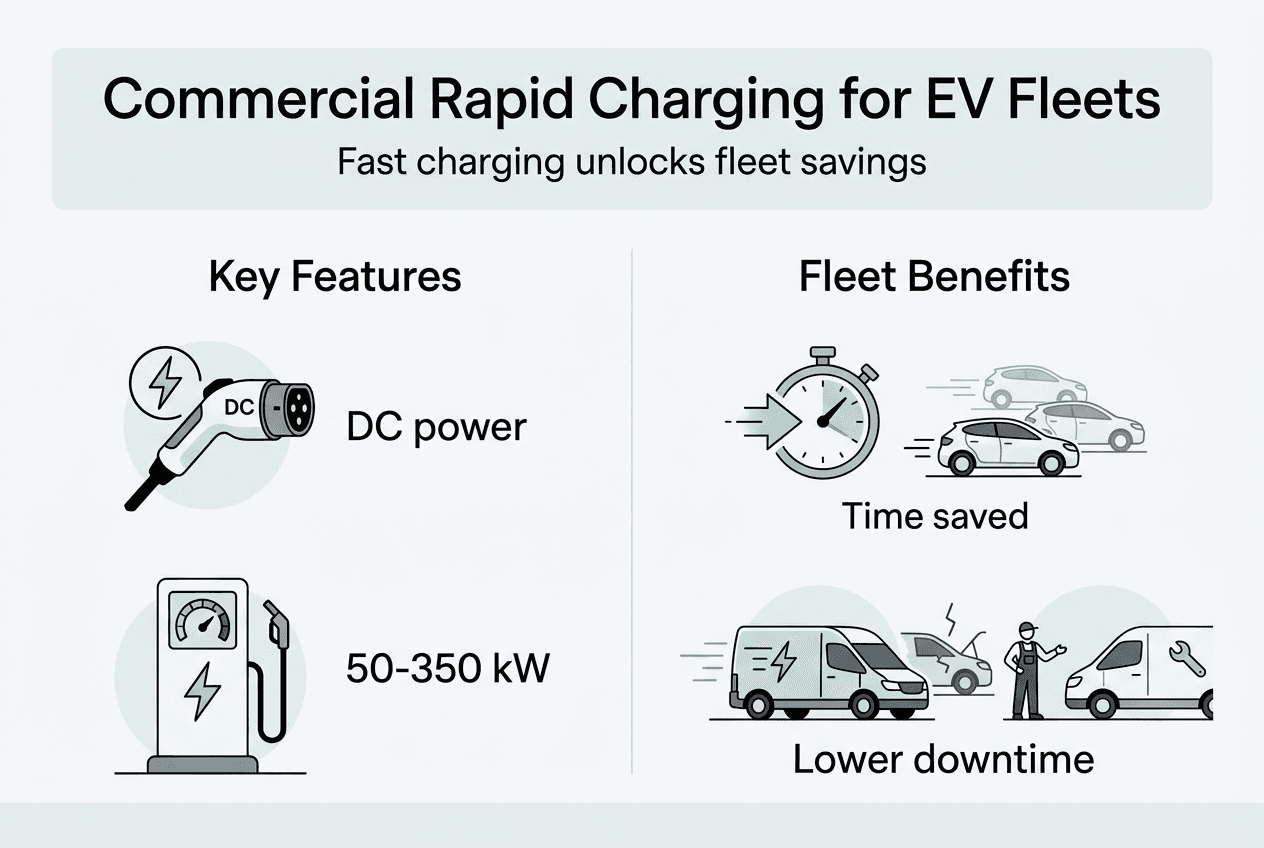
Commercial rapid charging represents a distinct category of EV charging infrastructure designed specifically for high-throughput applications. Unlike the 7-22 kW AC chargers common in residential settings, commercial rapid charging typically provides 50 kW to 350 kW power outputs to EVs, enabling 20-80% charge in 15-40 minutes. This dramatic difference in charging speed fundamentally changes how fleet managers can deploy electric vehicles without sacrificing operational tempo.
The technology relies on direct current delivery, bypassing the vehicle's onboard AC-to-DC converter and feeding power straight to the battery pack. This approach eliminates a significant bottleneck in the charging process. Most commercial rapid chargers use either CCS (Combined Charging System) or CHAdeMO connector standards, with CCS becoming the dominant choice for European fleets. The connector standard matters because it determines compatibility with your vehicle fleet and future-proofs your infrastructure investment.
Power output directly correlates with charging speed, but the relationship isn't perfectly linear due to battery management systems. A vehicle charging at a 150 kW rapid charger won't necessarily charge twice as fast as one at 75 kW throughout the entire session. Battery chemistry, temperature, and state of charge all influence actual charging rates. Most EVs accept maximum power only during the initial charging phase, typically from 10-60% state of charge, then taper power acceptance to protect battery longevity.
For fleet applications, these characteristics create predictable charging windows that managers can integrate into shift schedules and route planning. The key advantages for commercial operations include:
- Predictable turnaround times that support tight scheduling
- Reduced need for large vehicle reserves to cover charging downtime
- Flexibility to top up vehicles during breaks rather than requiring overnight charging
- Ability to recover from unexpected range depletion without major schedule disruption
Understanding these technical foundations helps you evaluate which electric DC rapid fleet chargers match your operational requirements and vehicle specifications.
Benefits of commercial rapid charging for fleet operations
The operational advantages of rapid charging extend far beyond simple time savings. Rapid charging can reduce vehicle downtime by up to 75%, significantly improving fleet productivity and allowing managers to operate with leaner vehicle pools. This efficiency gain translates directly to improved asset utilisation, one of the most important metrics in fleet management.

Scheduling flexibility represents another substantial benefit. With rapid charging, you can implement opportunity charging strategies where vehicles top up during driver breaks, loading periods, or shift changes. This approach eliminates the need to take vehicles out of service for extended charging sessions. Drivers can arrive, plug in during a 30-minute break, and depart with sufficient range for the next route segment. This flexibility proves especially valuable for operations with variable daily mileage or unpredictable service demands.
The financial impact on total cost of ownership deserves careful consideration. Whilst rapid charging infrastructure requires higher upfront investment than slower alternatives, the operational savings accumulate quickly. Reduced downtime means you need fewer vehicles to maintain the same service level. Lower fuel costs compared to diesel or petrol create ongoing savings. Maintenance costs drop significantly due to fewer moving parts and reduced wear on brake systems through regenerative braking.
Environmental benefits align with corporate sustainability goals that increasingly influence procurement decisions and customer preferences. Rapid charging enables practical electrification of fleet operations, reducing carbon emissions and local air pollution. Many organisations find that demonstrating commitment to sustainable operations provides competitive advantages in bidding for contracts and attracting environmentally conscious customers.
Pro Tip: Schedule your most intensive charging sessions during off-peak electricity periods to minimise demand charges whilst maintaining operational flexibility. Smart charging systems can automate this optimisation, ensuring vehicles charge when rates are lowest without requiring manual intervention.
The benefits of commercial rapid chargers compound over time as electricity grids become cleaner and vehicle technology improves. Early adopters position themselves advantageously for future regulatory changes and market shifts favouring electric mobility.
Infrastructure and installation considerations
Implementing commercial rapid charging requires thorough site evaluation and infrastructure planning. The electrical demands of rapid chargers significantly exceed typical commercial power requirements, necessitating careful assessment of existing capacity and potential upgrades. Proper electrical infrastructure planning is critical, often including upgrading transformers and switchgear to handle high rapid charging loads.
Your site evaluation should address these essential factors:
- Available electrical capacity and connection to the distribution network
- Physical space for charger installation and vehicle manoeuvring
- Distance from electrical service point to charging locations
- Ground conditions and civil works requirements
- Access for installation equipment and future maintenance
- Integration with existing fleet management systems
Electrical grid connection often represents the most complex aspect of installation. A single 150 kW rapid charger draws substantial power, and multiple units can strain local distribution capacity. You may need to coordinate with your distribution network operator to upgrade the service connection, install new transformers, or implement load management systems that prevent simultaneous peak demand from multiple chargers. These upgrades add cost and timeline complexity but remain essential for reliable operation.
The installation process typically unfolds in several phases. Initial site survey and electrical assessment identify requirements and constraints. Design and permitting follow, addressing building regulations, electrical codes, and any planning permissions. Civil works prepare the site, including trenching for power cables and installing foundations for charging equipment. Electrical installation connects chargers to the power supply with appropriate switchgear and protection. Finally, commissioning and testing verify proper operation before handover.
Compliance with UKCA certification and safety standards protects your investment and ensures legal operation. All charging equipment must meet relevant safety and electromagnetic compatibility requirements. Installation must comply with BS 7671 wiring regulations and other applicable standards. Working with certified installers and technical specifications for rapid chargers that meet UK requirements simplifies compliance and reduces risk.
| Charger Power | Typical Electrical Supply | Installation Complexity | Suited Fleet Size |
|---|---|---|---|
| 50 kW | Three-phase 400V, 125A | Moderate, may need supply upgrade | Small to medium (5-15 vehicles) |
| 150 kW | Three-phase 400V, 375A | High, typically requires transformer upgrade | Medium to large (15-40 vehicles) |
| 350 kW | Dedicated HV connection | Very high, requires substation work | Large fleets (40+ vehicles) |
Pro Tip: Engage with your electricity supplier early in the planning process to understand connection timelines and costs, which can significantly impact project schedules and budgets.
Financial planning and choosing the right commercial rapid charging solution
Financial planning for rapid charging infrastructure requires balancing upfront investment against long-term operational savings and strategic benefits. Initial costs include charging hardware, electrical infrastructure upgrades, installation labour, and any necessary civil works. These expenses vary widely depending on site conditions, required power capacity, and number of charging points. A basic 50 kW installation might cost £25,000-40,000, whilst a multi-unit 150 kW setup could exceed £200,000 including all infrastructure work.
Long-term savings offset these initial costs through multiple channels. Fuel cost reductions provide the most obvious benefit, with electricity typically costing 60-70% less per mile than diesel at current rates. Maintenance savings accumulate from reduced servicing requirements and longer component lifespans. Improved vehicle utilisation from reduced downtime creates value that's harder to quantify but equally real. UK fleet operators often recover investment in rapid charging infrastructure within 3-5 years through savings and operational efficiency.
Financial incentives and grants can substantially reduce net investment costs. The UK government periodically offers schemes supporting commercial EV infrastructure, though availability and terms change. Local authorities sometimes provide additional incentives to encourage fleet electrification. Your electricity supplier may offer favourable connection terms or reduced rates for EV charging to support grid balancing. Investigating all available support programmes before finalising your investment plan can significantly improve project economics.
Selecting the right charging solution requires matching technical specifications to your operational profile. Consider these factors:
- Daily mileage and energy consumption patterns across your fleet
- Available charging windows during shifts, breaks, or overnight periods
- Vehicle battery capacities and maximum charging rates
- Growth plans for fleet size and operational intensity
- Budget constraints for initial investment and ongoing costs
| Charger Type | Power Output | Typical Cost | Best For | Key Consideration |
|---|---|---|---|---|
| Standard Rapid | 50-75 kW | £20,000-35,000 | Small fleets, moderate daily mileage | Lower infrastructure demands |
| High-Power Rapid | 150-180 kW | £45,000-75,000 | Medium fleets, intensive operations | Balances speed and cost |
| Ultra-Rapid | 300-350 kW | £100,000-150,000 | Large fleets, maximum throughput | Requires substantial infrastructure |
Matching charging capacity to actual needs prevents both under-investment that creates operational bottlenecks and over-investment in unnecessary capability. A fleet with predictable routes and adequate overnight charging windows may function perfectly well with lower-power rapid charging supplemented by AC charging. Conversely, operations with unpredictable demands and tight turnaround requirements benefit from higher-power solutions despite greater cost.
Exploring rapid charging pricing models helps you understand total cost of ownership and identify the most economical solution for your specific circumstances.
Explore Syncrofleet rapid charging solutions
Syncrofleet specialises in providing UKCA-certified rapid charging solutions designed specifically for commercial fleet operations. Our product range includes chargers from 50 kW to 350 kW, allowing you to select the optimal configuration for your fleet size and operational requirements. We understand that every fleet faces unique challenges, and our technical team works with you to design charging infrastructure that maximises efficiency whilst controlling costs.
Our Syncrofleet rapid charging products combine reliability with cost-effectiveness, helping you transition to electric mobility without compromising operational performance. We provide comprehensive support from initial site assessment through installation and ongoing maintenance. Detailed technical specifications and transparent pricing options for rapid chargers enable informed decision-making. Contact our team to discuss your fleet requirements and discover how commercial rapid charging can enhance your operations.
FAQ
What is the difference between rapid and ultra-rapid charging?
Rapid charging typically refers to chargers delivering 50-150 kW, whilst ultra-rapid describes units providing 150 kW and above. Ultra-rapid chargers enable faster top-up times, potentially reducing charging sessions from 30-40 minutes to 15-20 minutes for the same state of charge increase. However, they require more substantial electrical infrastructure and higher investment. Your vehicle fleet must also support higher charging rates to benefit from ultra-rapid capability.
How does commercial rapid charging impact fleet electricity costs?
Electricity demand charges may increase due to the high instantaneous power draw of rapid chargers, particularly if multiple units operate simultaneously. However, overall energy costs typically remain 60-70% lower than equivalent diesel or petrol fuel expenses. Smart energy management systems can optimise charging schedules to minimise demand charges by distributing load across time and managing peak power consumption. Many operators find that total energy costs decrease substantially despite higher per-connection demand.
Can commercial rapid charging be integrated with renewable energy sources?
Yes, integrating rapid chargers with solar panels or wind turbines reduces both carbon footprint and long-term operating costs. On-site renewable generation can offset grid electricity consumption, though rapid charging's high instantaneous power requirements often exceed what on-site generation can provide alone. Energy storage systems enhance renewable integration by storing excess generation for later use during charging sessions. This combination creates a more sustainable and potentially more economical charging solution, particularly as battery storage costs continue declining.
What maintenance do commercial rapid chargers require?
Rapid chargers require relatively minimal maintenance compared to traditional fuelling infrastructure. Regular inspections should verify cable condition, connector integrity, and proper operation of safety systems. Software updates maintain optimal performance and security. Most manufacturers recommend annual professional servicing to check electrical connections, cooling systems, and power electronics. Keeping charging areas clean and accessible prevents minor issues from becoming operational problems. Well-maintained rapid chargers typically provide 10-15 years of reliable service with minimal downtime.
How do I determine how many rapid chargers my fleet needs?
Calculate total daily energy consumption across your fleet, then divide by available charging time to determine required charging capacity. Factor in peak demand periods when multiple vehicles need charging simultaneously. Consider future fleet growth and operational changes that might increase requirements. A general rule suggests one rapid charger per 3-5 vehicles for intensive operations, though your specific utilisation patterns may differ significantly. Consulting with experienced providers helps optimise the balance between adequate capacity and cost-effective investment.