
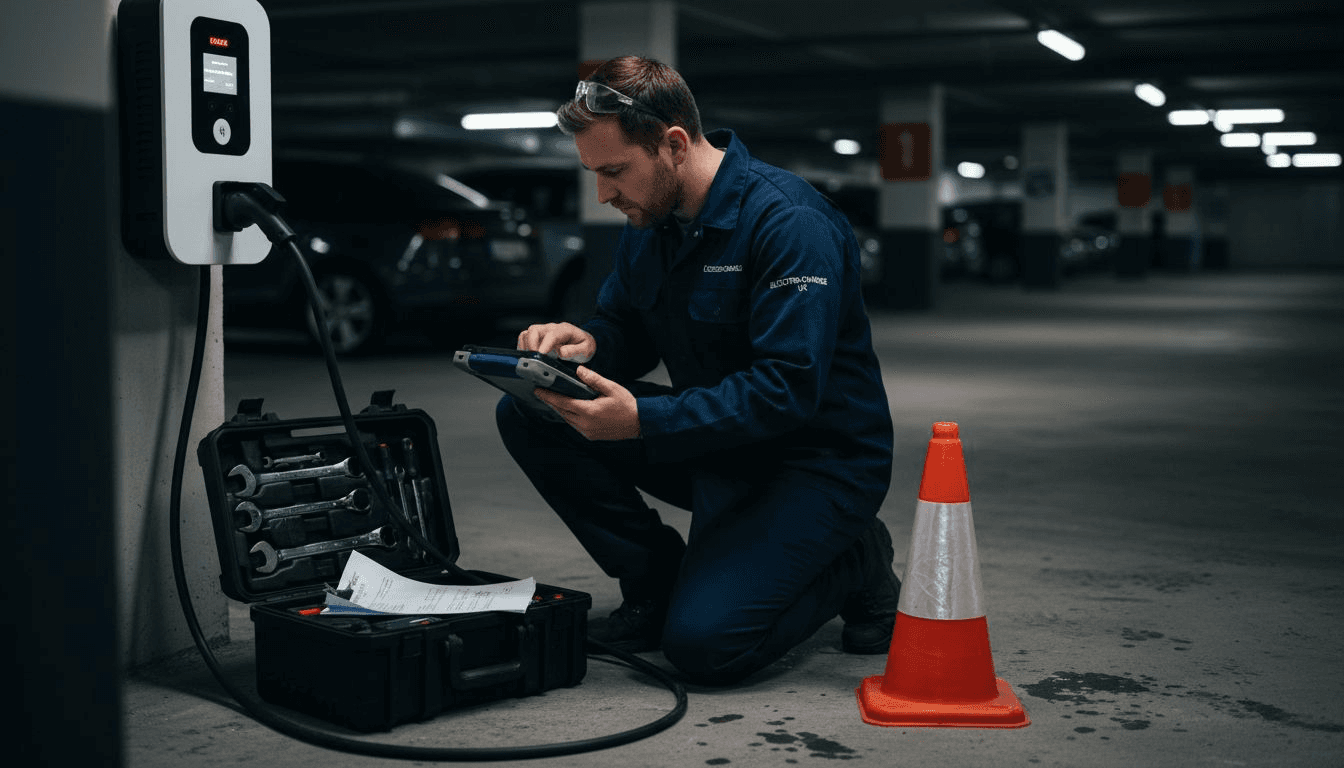
Fleet managers and electrical project leaders face a pressing challenge in 2026: 70-80% of EV charging occurs at dedicated facilities, yet unreliable charging infrastructure creates costly downtime and project delays. When charging equipment fails, systematic troubleshooting becomes essential to maintain operational continuity. This guide provides electrical project managers and fleet procurement professionals with a structured methodology to diagnose and resolve common EV charging faults efficiently, combining safety protocols with advanced diagnostic techniques to minimise disruption and maximise fleet availability.
Table of Contents
- Preparing To Troubleshoot EV Charging Issues
- Systematic Execution: Step-By-Step Troubleshooting Process
- Common Challenges And Specialised Diagnostics In EV Charging
- Best Practices For Fleets And Procurement Managers To Reduce EV Charging Downtime
- Enhance Your Fleet's Charging Reliability With Syncrofleet Solutions
- FAQ About Troubleshooting EV Charging Issues
Key takeaways
| Point | Details |
|---|---|
| Systematic fault classification | Organise issues into supply, circuit, device and load categories for faster isolation and resolution |
| Safety first approach | Always verify GFCI compliance and check for visible damage before conducting electrical diagnostics |
| Advanced detection methods | AI and hybrid fault detection achieve over 85% accuracy, enabling autonomous resolution in many cases |
| Performance metrics matter | First-time charge success rate provides better operational insight than simple uptime measurements |
| Preventive procurement | Select EVSE with edge AI, quality sensors and OCPP compliance to reduce future troubleshooting needs |
Preparing to troubleshoot EV charging issues
Before initiating any diagnostic work, establish a safe working environment and gather the necessary tools. Begin with visual and sensory safety checks: inspect for smoke odours, verify whether circuit breakers have tripped, and examine equipment for visible damage such as scorched connectors or melted housings. These preliminary observations often reveal the fault category immediately.
Assemble essential diagnostic equipment including a digital multimeter capable of measuring AC and DC voltage, insulated inspection gloves rated for electrical work, and a fault code reader compatible with your EVSE models. Many modern charging stations provide diagnostic codes through display panels or mobile applications, streamlining initial fault identification. Check cable integrity along the entire length, paying particular attention to connector pins and strain relief points where mechanical stress concentrates.
Establish a systematic troubleshooting framework that examines the complete charging ecosystem: the vehicle itself, the electrical supply infrastructure, and the charging equipment. This holistic approach prevents overlooking interconnected issues that span multiple system components. NEC 625.54 mandates GFCI protection for Level 2 charging installations, and immediate breaker trips often indicate ground fault conditions requiring immediate attention.
Pro Tip: Create a fault symptom matrix linking observable behaviours to probable causes. For example, immediate breaker trips typically suggest ground faults, whilst slow charging rates often indicate voltage drop or circuit impedance issues.
Essential pre-troubleshooting safety checklist:
- Verify circuit breaker status and rating matches EVSE requirements
- Inspect cable insulation for cuts, abrasions or thermal damage
- Check connector pins for corrosion, deformation or foreign material
- Confirm GFCI functionality using the test button
- Review recent fault codes or error logs if available
| Safety element | Verification method | Acceptable threshold |
|---|---|---|
| GFCI response time | Test button activation | Immediate trip |
| Cable insulation | Visual and tactile inspection | No visible damage |
| Connector resistance | Multimeter measurement | Below 0.5 ohms |
| Supply voltage | Panel measurement | Within ±5% of nominal |
A methodical approach resolves most issues without requiring battery replacement or extensive component swaps. Proper preparation reduces diagnostic time and prevents safety incidents during troubleshooting activities.
Systematic execution: step-by-step troubleshooting process
Implement a structured diagnostic sequence that progressively narrows the fault location from supply to load. This methodical progression prevents wasted effort and ensures comprehensive coverage of potential failure points.
-
Verify power source integrity: Measure voltage and phase balance at the distribution panel supplying the EVSE circuit. Single-phase installations should show 230V ±5%, whilst three-phase systems require balanced voltages across all phases within 2% variance. Record these baseline measurements for comparison during subsequent steps.
-
Inspect EVSE operation and codes: Examine the charging station's indicator lights and retrieve any stored fault codes. Modern EVSE units display specific error messages indicating communication failures, ground faults, overcurrent conditions or thermal shutdowns. Consult the manufacturer's fault code reference to interpret these diagnostics accurately.
-
Check circuit integrity: Measure voltage at the EVSE input terminals and compare with panel readings. Significant voltage drop exceeding 3% suggests circuit problems such as loose connections, undersized conductors or high-resistance joints. Inspect all connection points along the circuit path, including junction boxes and disconnect switches.
-
Diagnose vehicle-side issues: If supply and circuit measurements appear normal, focus on the vehicle interface. Check the vehicle's charging port for debris, damaged pins or moisture intrusion. Attempt charging with a known-good vehicle to isolate whether the fault resides in the EVSE or the original vehicle. Review the vehicle's onboard diagnostic codes related to charging system operation.
-
Escalate complex faults: When initial diagnostics fail to isolate the problem, or when specialised equipment becomes necessary, engage qualified electrical contractors or EVSE service providers. Document all measurements and observations to facilitate efficient handover.
Pro Tip: Voltage comparison between panel and EVSE reveals circuit faults quickly. A drop exceeding 5V under load indicates excessive circuit resistance requiring immediate correction.
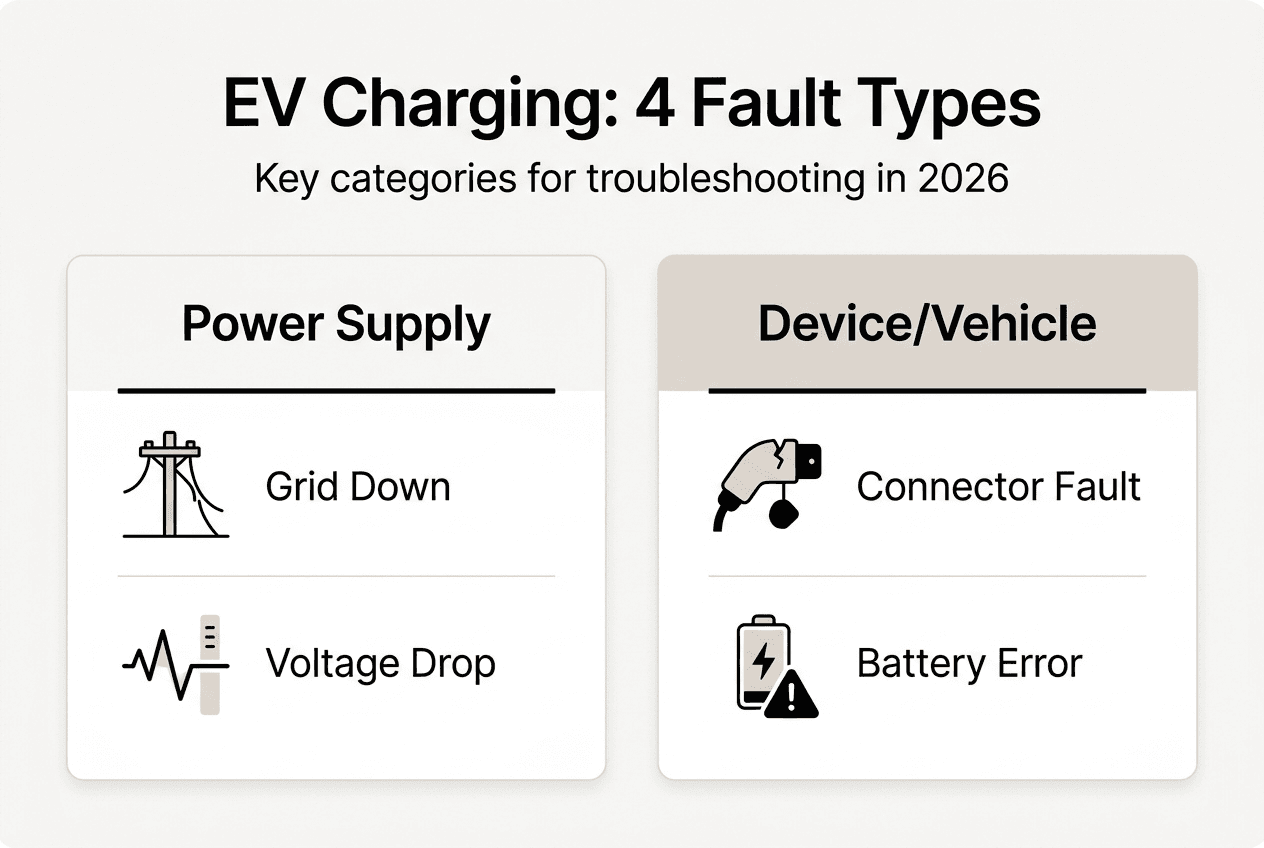
Classify faults into four categories: supply-side issues originate at the distribution panel, circuit-side problems occur in wiring between panel and EVSE, device-level faults affect the charging station itself, and load-side issues involve the vehicle's charging system. This classification streamlines diagnosis by focusing attention on the appropriate system segment.
| Diagnostic step | Measurement point | Expected reading | Action if abnormal |
|---|---|---|---|
| Supply voltage | Distribution panel | 230V ±5% | Check utility supply |
| Circuit voltage | EVSE input | Within 3% of panel | Inspect connections |
| Ground continuity | EVSE to panel ground | Below 1 ohm | Repair ground path |
| Load current | EVSE output during charging | Matches vehicle rating | Check vehicle system |
This systematic approach ensures thorough evaluation whilst minimising diagnostic time. Each step builds upon previous measurements, creating a logical path to fault isolation.
Common challenges and specialised diagnostics in EV charging
Fleet operations encounter recurring charging issues that demand specialised diagnostic approaches. Understanding these prevalent problems and advanced detection methods enables faster resolution and improved system reliability.
Hardware failures represent a significant challenge in public and fleet charging infrastructure. Public DC fast chargers experience 27.5% non-functional rates, with hardware faults causing 36% of reported problems. Common hardware issues include failed contactors, degraded power modules, malfunctioning communication boards and worn cable assemblies. These failures often present intermittently, complicating diagnosis through standard troubleshooting procedures.
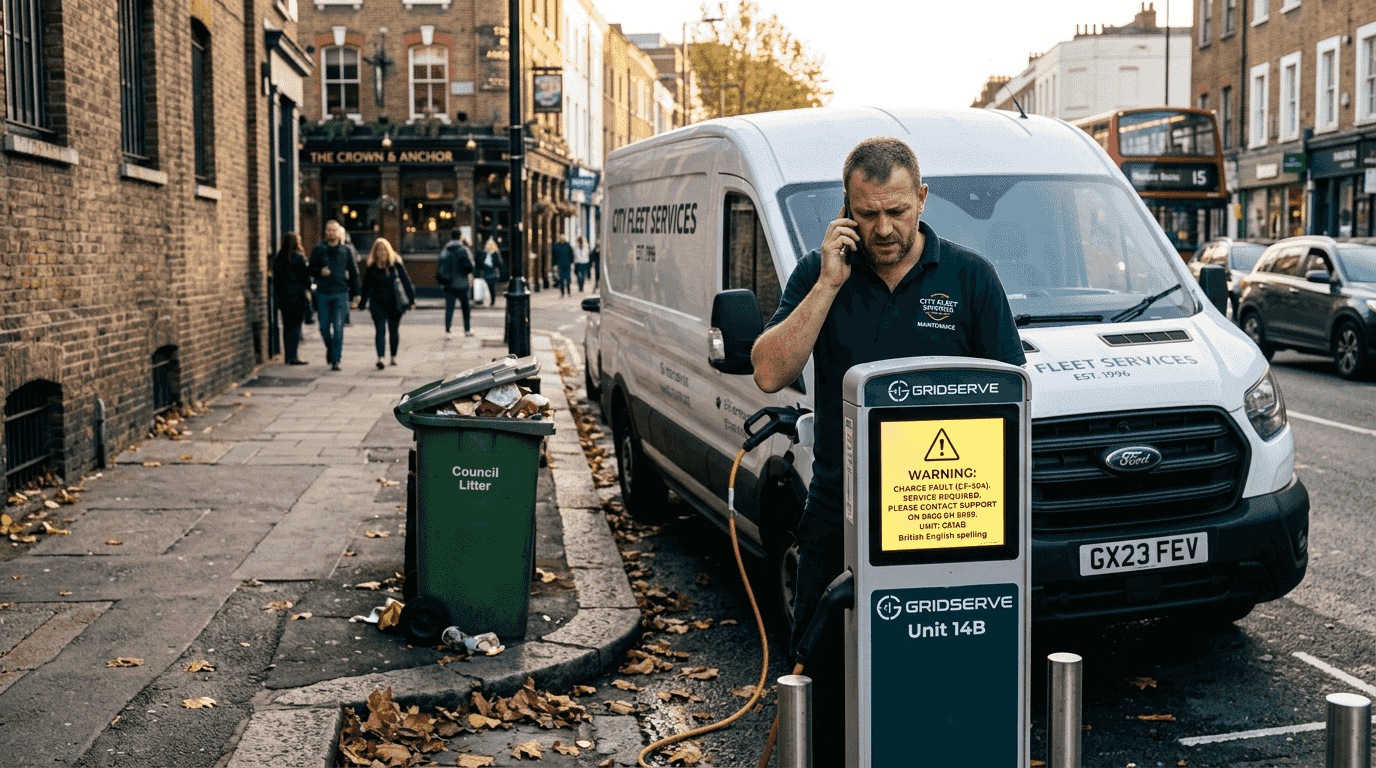
Power quality disturbances create subtle charging problems that traditional diagnostics may overlook. Voltage sags reduce charging speed without triggering fault codes, whilst voltage swells can damage sensitive EVSE electronics. Harmonic distortion from nearby non-linear loads interferes with charging control circuits, causing communication errors between vehicle and EVSE. Fleet installations in industrial environments face particular vulnerability to these power quality issues.
Advanced diagnostic methodologies address complex fault scenarios more effectively than manual troubleshooting alone. AI-driven fault detection achieves over 85% accuracy, enabling autonomous resolution for 78% of detected cases. These systems analyse patterns in voltage, current and communication data to identify developing faults before complete failure occurs. Hybrid approaches combining AI analysis with traditional rule-based diagnostics provide robust fault coverage across diverse operating conditions.
Empirical data from fleet operations reveals temporal patterns in charging reliability. First-time charge success rates fluctuate significantly across different times and locations, with hardware age and environmental factors contributing to variability. Equipment approaching end-of-life exhibits increased fault frequency, requiring more intensive monitoring and proactive replacement strategies.
"Fleet managers must recognise that charging infrastructure reliability depends on multiple interconnected factors. Hardware quality, power supply stability, environmental conditions and maintenance practices all influence operational performance. Addressing these elements holistically produces better outcomes than focusing solely on equipment troubleshooting."
Common power quality issues affecting EV charging:
- Voltage sags during high-demand periods reduce charging current and extend session duration
- Transient overvoltages from switching operations damage EVSE power electronics
- Harmonic distortion interferes with vehicle-to-EVSE communication protocols
- Phase imbalance in three-phase installations causes uneven loading and potential overheating
- Power factor displacement increases utility costs and reduces available charging capacity
AI-enabled EVSE incorporates edge computing to analyse operational data in real time, detecting anomalies that indicate developing faults. This proactive approach reduces unexpected failures and enables scheduled maintenance during low-demand periods.
Best practices for fleets and procurement managers to reduce EV charging downtime
Strategic equipment selection and operational practices significantly impact charging reliability and fleet productivity. Procurement decisions made today determine troubleshooting requirements for years ahead.
Select EVSE incorporating edge AI capabilities, high-quality voltage and current sensors, and OCPP (Open Charge Point Protocol) compliance. Edge AI enables local fault detection and autonomous corrective actions without cloud connectivity delays. Quality sensors provide accurate measurements essential for precise diagnostics, whilst OCPP compliance ensures interoperability with fleet management systems and facilitates remote monitoring.
Implement comprehensive remote monitoring across all charging assets. Cloud-connected EVSE transmits operational data, fault codes and performance metrics to central management platforms, enabling rapid response to developing issues. Remote monitoring reduces mean time to repair by alerting maintenance teams immediately when faults occur, often before drivers report problems.
Prioritise first-time charge success rate over simple uptime metrics when evaluating charging infrastructure performance. FTCSR measures the percentage of charging attempts that complete successfully without requiring driver intervention or retries. This metric better reflects actual user experience than uptime measurements, which may count non-functional chargers as operational if powered on. Fleet KPIs should incorporate FTCSR alongside traditional availability metrics.
Account for equipment ageing in maintenance planning and budget forecasting. Charging stations experience performance degradation over time, with increased fault frequency as components approach end-of-life. Establish replacement cycles based on actual reliability data rather than arbitrary timeframes. Consider equity factors when deploying charging infrastructure, ensuring disadvantaged communities receive equivalent access to reliable charging facilities.
Maintain standardised fault code documentation across all EVSE models in your fleet. Consistent coding schemes accelerate troubleshooting by enabling technicians to quickly interpret error messages regardless of equipment manufacturer. Train maintenance personnel on systematic diagnostic procedures and provide access to necessary test equipment.
Pro Tip: Establish baseline performance metrics for each charging location during initial commissioning. Track FTCSR, average session duration and fault frequency monthly to identify degrading performance trends before they impact operations significantly.
Strategic procurement considerations:
- Evaluate EVSE manufacturers' field reliability data and warranty terms
- Verify availability of replacement parts and local service support
- Confirm cybersecurity features protecting charging infrastructure from network threats
- Assess integration capabilities with existing fleet management platforms
- Review manufacturer's software update policies and historical update frequency
Explore robust EVSE product selections that meet fleet operational requirements whilst minimising long-term troubleshooting needs. High-quality sensors and OCPP support reduce diagnostic complexity and enable proactive maintenance strategies.
Enhance your fleet's charging reliability with Syncrofleet solutions
After implementing systematic troubleshooting practices, consider how purpose-built charging infrastructure can reduce future diagnostic requirements. Syncrofleet offers UKCA-certified electric DC rapid fleet chargers designed specifically for demanding fleet applications where reliability directly impacts operational efficiency.
Our EV charging products incorporate advanced diagnostic capabilities and real-time monitoring features that streamline fault detection and resolution. Each unit provides detailed operational data enabling proactive maintenance before minor issues escalate into costly downtime events.
Review our technical specifications to understand how Syncrofleet chargers meet rigorous performance standards whilst maintaining compatibility with diverse fleet vehicle types. Discover why fleet managers choose Syncrofleet for reliable, cost-effective charging solutions that minimise troubleshooting requirements through robust design and intelligent diagnostics.
FAQ about troubleshooting EV charging issues
How often should EV charging equipment be inspected to prevent faults?
Conduct visual inspections monthly, checking cables, connectors and housing for damage. Perform comprehensive electrical testing quarterly, measuring voltage, current and ground continuity. Schedule professional maintenance annually or after 50,000 charging sessions, whichever occurs first.
What are common signs of power supply issues affecting EV charging?
Flickering indicator lights, intermittent charging sessions and reduced charging speeds indicate supply problems. Measure voltage at the distribution panel during charging to identify sags or imbalances. Voltage drops exceeding 5% require circuit investigation.
Can AI diagnostics completely replace human troubleshooting?
AI systems excel at pattern recognition and autonomous resolution of common faults, handling 78% of cases independently. However, novel failure modes, physical damage assessment and complex electrical measurements still require human expertise. Hybrid approaches combining AI and technician skills produce optimal results.
What is the difference between charger uptime and first-time charge success rate?
Uptime measures whether equipment is powered and responsive, but does not confirm functional charging capability. FTCSR tracks successful charge completions without driver intervention, providing a more accurate indicator of actual user experience and operational reliability.
How can ageing equipment impact my fleet's charging reliability?
Older charging stations experience increased component failures, particularly in contactors, power modules and communication circuits. Degraded performance manifests as slower charging speeds, higher fault frequency and reduced first-time success rates. Plan equipment replacement based on reliability trends rather than fixed age thresholds.